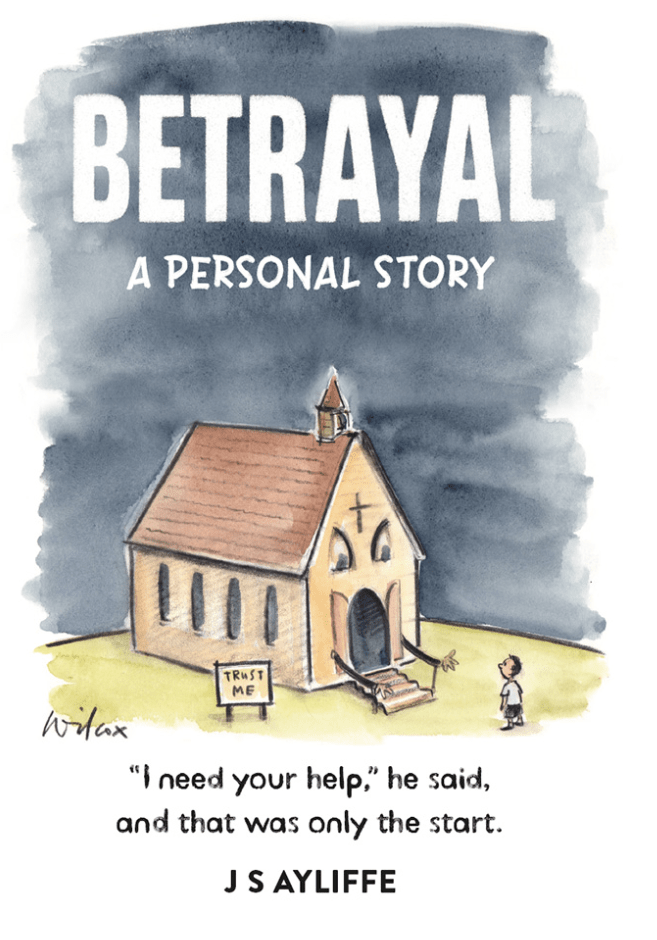
Betrayal: A Personal Story by J S Ayliffe
Returning from retreat, with the quiet still lingering in my mind, I picked up Betrayal — A Personal Story by J. S. Ayliffe. It’s not the kind of book you ease into; it’s the kind that meets you at the threshold and asks you to walk into difficult territory with your eyes open. Ayliffe’s account begins in 1989, when he was asked by a senior Catholic official to help conceal clerical child abuse—an act that would shadow him for twenty‑five years. Reading it after days of silence made the story land with even more weight. There’s something about stillness that sharpens your sense of what matters, and this book demands that kind of attention.
Ayliffe’s narrative is not simply a confession, nor is it a straightforward memoir. It’s a reckoning—with complicity, conscience, and the long cost of institutional loyalty. What surprised me most is how interwoven his story is with the voices of survivors. Chrissie Foster, Ian Lawther, and others appear not as background figures but as central moral anchors. Their suffering, their courage, and their persistence shape the emotional landscape of the book. Ayliffe does not centre himself as a hero or even as a victim; he positions himself honestly as someone who stood at the edge of wrongdoing, knew more than he admitted, and lived for decades with the weight of silence.
What makes the book so compelling is that it isn’t only about the crimes themselves—though those are devastating enough. It’s about what happens to the people who know, who look away, who rationalise, who stay loyal to an institution even when that loyalty corrodes their own integrity. Ayliffe writes with a kind of moral clarity that feels earned, not assumed. He doesn’t excuse himself, and he doesn’t sensationalise the suffering of others. Instead, he invites the reader into the uncomfortable truth that complicity is rarely dramatic; it’s often quiet, incremental, and socially reinforced. That’s part of what makes this story so important.
There are moments in the book that linger long after reading. Ayliffe’s description of the request to conceal abuse is chilling precisely because of its ordinariness—the way institutional wrongdoing often hides behind polite language and hierarchical obedience. The survivors’ testimonies, though not dwelled on gratuitously, are deeply affecting. And the sections reflecting on Australia’s Royal Commission into Institutional Responses to Child Sexual Abuse offer a sobering look at how long justice can take, and how incomplete it often feels even when it arrives.
One reviewer, Ashleigh C, noted that she expected a more personal memoir and instead found a broader historical account of offenders, cover‑ups, trials, and institutional failures. That’s a fair observation. Readers looking for an intimate, confessional narrative may find the book more expansive and documentary in tone than anticipated. But for me, that breadth strengthens the story rather than diluting it. Ayliffe’s personal reckoning gains depth when placed against the wider pattern of systemic abuse and concealment. His story becomes one thread in a much larger tapestry of institutional betrayal.
What I carried away from the book is a renewed awareness of how fragile trust is—and how sacred. Institutions can speak of moral authority, but authority without accountability becomes dangerous. Ayliffe’s journey shows how easily good intentions can be co‑opted, how silence can become a habit, and how long it can take to confront the truth. Yet there is also something quietly hopeful in his willingness to finally speak, to name what happened, and to stand with survivors rather than behind the institution that failed them.
For readers of Witness or The Altar Boy, or for anyone grappling with questions of institutional accountability, moral courage, and the long arc of justice, this book is a powerful companion. It’s not an easy read, nor should it be. But it is an important one—one that asks us to look honestly at the systems we trust, the loyalties we hold, and the responsibilities we carry when we know something is wrong.
 I write about Stuff