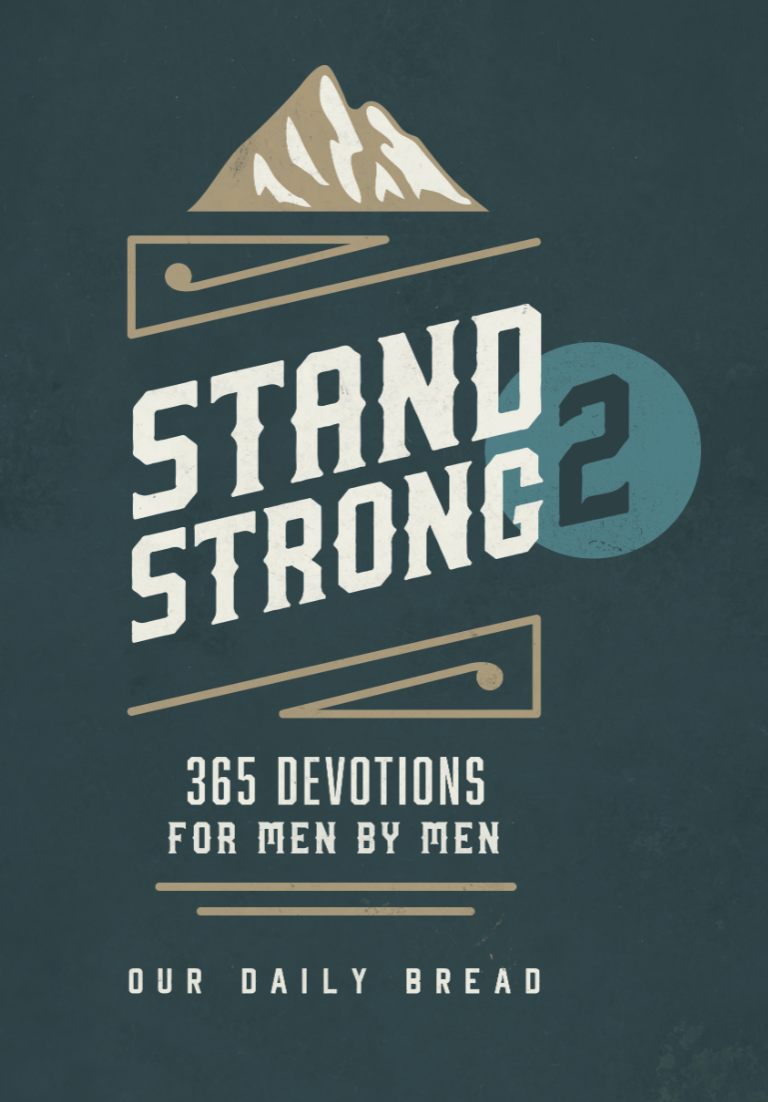
by Our Daily Bread Ministries
A book review
#StandStrong2 #NetGalley
What Is This Book?
There are seasons when the thought of adding one more thing to the day, even something worthwhile, feels impossible. That is perhaps where a devotional book like this finds its place. Stand Strong offers 365 short daily readings, each intended to take five minutes or less, with the aim of helping men develop a regular habit of engaging with Scripture and reflecting on how Christian faith connects with ordinary life.
The format is deliberately simple. Each day includes a suggested Bible reading, a key verse, a short story or illustration and a reflection intended to bring the biblical material into the reader’s home, workplace or community.
Its guiding verse, 1 Corinthians 16:13, sets the tone: “Be on your guard; stand firm in the faith; be courageous; be strong.” Strength, perseverance and faithfulness are therefore central themes. This is not a book promising an easy life. Instead, it sets out to encourage readers to remain faithful when life becomes difficult.
Who Is It For?
The book describes itself very clearly as a collection “written by men for men”. That immediately raises an interesting question: what makes a devotional particularly male?
There is certainly value in producing resources with a particular audience in mind. Some men who would hesitate to pick up a longer Christian book may find the short, direct format approachable. Equally, someone wanting to establish a regular pattern of Bible reading without quite knowing where to begin could find the structure helpful.
Yet I was left wondering whether emphasising strength and courage as particularly male concerns is always necessary. Perseverance, vulnerability, fear, doubt, courage and faithfulness are not uniquely male experiences. Perhaps the real test is whether the writers allow enough breadth for different personalities and experiences of being a man, rather than offering a single model of what Christian masculinity should look like.
What Works?
The accessibility of the format is one of the book’s obvious strengths. Five minutes is manageable. There is little opportunity for the familiar excuse, “I simply haven’t time.”
The January 14 devotion, “Unbreakable in Jesus”, demonstrates the approach well. It begins with the remarkable wartime experiences of Louis Zamperini before turning to the prophet Jeremiah. Jeremiah endured opposition, imprisonment and physical suffering, yet continued because of God’s promise to remain with him.
The connection is easy to follow. Neither Jeremiah nor Zamperini escaped suffering, but suffering was not presented as evidence that God had abandoned them. The reflection then brings that idea into the reader’s experience: Christian hope does not necessarily mean avoiding difficulty, but trusting that God remains present within it.
That is a useful corrective to versions of Christianity which can unintentionally imply that sufficient faith should result in a trouble-free life.
The storytelling also makes the theological point memorable. Readers who might struggle to remember a more abstract discussion of perseverance may remember a person drifting at sea or Jeremiah being lowered into a cistern.
What Gave Me Pause?
The strength of that story also exposes a possible weakness in this style of devotional writing.
Most of us are not dealing with plane crashes, prisoner-of-war camps or biblical levels of persecution. We are dealing with family tensions, disappointment, financial pressures, illness, work, loneliness, uncertainty and the thousand smaller difficulties that accumulate in ordinary life.
Extraordinary stories can inspire us, but there is always a risk that they make ordinary struggles seem insignificant. I would want a devotional collection like this to reassure the reader that God is present not only in heroic endurance but also in the quiet, unimpressive business of getting through Tuesday.
There is another potential difficulty with very short devotions. Scripture can become an illustration for the point the writer wants to make rather than something the reader is encouraged to wrestle with in its own right. The inclusion of a suggested Bible passage is therefore important. Ideally, the devotion should be the doorway into Scripture rather than a substitute for reading it.
Does the Format Work?
For what the book is trying to achieve, largely yes.
A five-minute devotion cannot provide detailed biblical scholarship, nor should it pretend to. Its purpose is different. It creates a daily stopping place, somewhere between the speed of everyday life and the depth of sustained Bible study.
The regular pattern may be particularly valuable. There is something quietly significant about opening Scripture each day, even briefly. Spiritual habits are not always dramatic. Often they are built through small acts repeated faithfully.
The danger, of course, is allowing “five minutes with God” to become another item successfully ticked off the list. The best entries will therefore be those that leave the reader thinking after the book has been closed.
Would I Actually Use It?
This, for me, is the most practical test of a devotional book.
I can imagine Stand Strong working particularly well for someone who wants to develop a daily devotional habit but finds longer material daunting. It could also be useful as a gift for someone going through a difficult period, provided the tone of the individual readings fits their circumstances.
I could also see individual reflections opening worthwhile conversations in a men’s group or other small-group setting. A story such as the January 14 reading naturally raises bigger questions: What does Christian strength actually look like? Is being strong the same as appearing strong? Where is God when circumstances do not improve?
Those questions may take considerably longer than five minutes, and perhaps that is a sign that the devotion has done its job.
The Verdict
Stand Strong does not set out to be a theological textbook or comprehensive Bible commentary. It offers something much simpler: a manageable daily invitation to open Scripture, pause and consider what following Jesus might mean in ordinary life.
Its brevity is both its strength and its limitation. Some readers will want considerably more depth, while others may discover that five minutes is exactly the place they need to begin.
Ultimately, a devotional book succeeds not because every reflection is unforgettable, but because it encourages us to look beyond the devotional itself. If Stand Strong sends its readers back into Scripture, into prayer, and then into home, workplace and community with a more deeply rooted faith, it will have achieved something worthwhile.
Leave a Reply