Nehemiah admitted he couldn’t do it alone
Scripture: Nehemiah 1:4–11; Psalm 127:1; 2 Corinthians 12:9
Before Nehemiah lifted a stone or drafted a plan, he wept, fasted, confessed, and prayed. He didn’t pretend to be strong enough. He didn’t rely on competence, strategy, or leadership technique. He began with dependence.
- Nehemiah 1:4 — “I sat down and wept… I fasted and prayed before the God of heaven.”
- Nehemiah 1:6–7 — He confesses not only Israel’s sins but his own.
- Psalm 127:1 — “Unless the Lord builds the house, the builders labour in vain.”
- 2 Corinthians 12:9 — God’s power is made perfect in weakness.
Work Connection
In the workplace, we often feel pressure to appear competent, confident, and in control. But Scripture consistently teaches that humility is the beginning of fruitful work. Nehemiah models:
- Honest self-assessment
- Confession as preparation for leadership
- Prayer as strategic planning
- Dependence on God as the foundation for action
This is not passivity. It is alignment. Nehemiah’s prayer moves him into courageous work.
Nehemiah used the relationships and resources God had already placed around him
Scripture: Nehemiah 2:1–8; Proverbs 3:4–6; Exodus 3–4
Nehemiah didn’t spiritualise his calling into isolation. He approached the king—his employer—and asked boldly for:
- Permission
- Protection
- Provision
Nehemiah 2:8 — “Because the gracious hand of my God was upon me, the king granted my requests.”
This is a profound theology-of-work moment: God works through human structures, not just around them.
Work Connection
Your workplace relationships, networks, skills, and influence are not accidental. They are part of your calling.
- God used Pharaoh’s daughter to save Moses.
- God used Cyrus to send Israel home.
- God used the king of Persia to resource Nehemiah.
Work is one of the primary places where God provides resources for His purposes. Nehemiah shows us that asking boldly is not unspiritual—it is faithful stewardship.
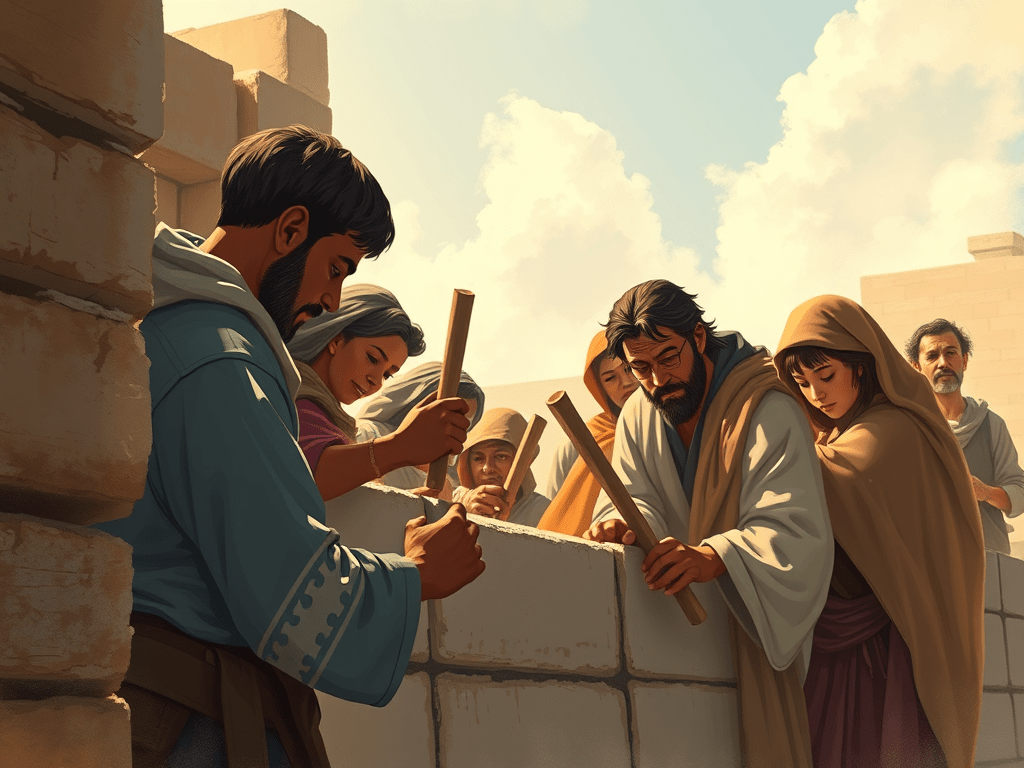
Nehemiah gathered a team instead of working alone
Scripture: Nehemiah 2:17–18; Nehemiah 3; Ecclesiastes 4:9–12; Romans 12:4–8
Nehemiah understood that a personal calling does not equal a solo mission.
Nehemiah 2:17 — “You see the trouble we are in… Come, let us rebuild.” Nehemiah 3 — A whole chapter listing workers, families, guilds, and teams.
He didn’t confuse:
- Personal responsibility with
- Individual responsibility
Work Connection
Work is designed to be collaborative.
- Ecclesiastes 4:9 — “Two are better than one.”
- Romans 12:4–5 — We are one body with many members.
- Ephesians 4:16 — The body grows as “each part does its work.”
Nehemiah models:
- Shared ownership
- Distributed leadership
- Community transformation through collective effort
In ministry, leadership, and everyday work, isolation is often a sign not of holiness but of exhaustion. Nehemiah shows us the holiness of teamwork.
Nehemiah accepted imperfect beginnings and ignored the critics
Scripture: Nehemiah 4:1–6; Zechariah 4:10; Galatians 6:9
When the wall was only half its height, the critics laughed.
Nehemiah 4:3 — “Even a fox climbing on it would break down their wall!”
But Nehemiah wasn’t building a wall. He was building a people.
Work Connection
Every meaningful task—whether spiritual or practical—begins in weakness.
- Zechariah 4:10 — “Do not despise the day of small beginnings.”
- Galatians 6:9 — “Let us not grow weary in doing good.”
- Nehemiah 4:6 — “The people worked with all their heart.”
Nehemiah teaches us:
- Early progress often looks unimpressive
- Critics are loudest when the work is most important
- Perseverance is a spiritual discipline
- God forms us through the work, not just through the outcome
The wall was half-built, but the people were becoming whole.
Bringing It All Together
Nehemiah’s overwhelming task became possible because he:
- Turned from self-reliance to God-reliance
- Turned to those with resources
- Turned to co-labourers
- Turned a deaf ear to critics
This is the shape of faithful work—whether you’re rebuilding a city, leading worship in West Cork, writing an academic assignment, or shepherding a community.
 I write about Stuff