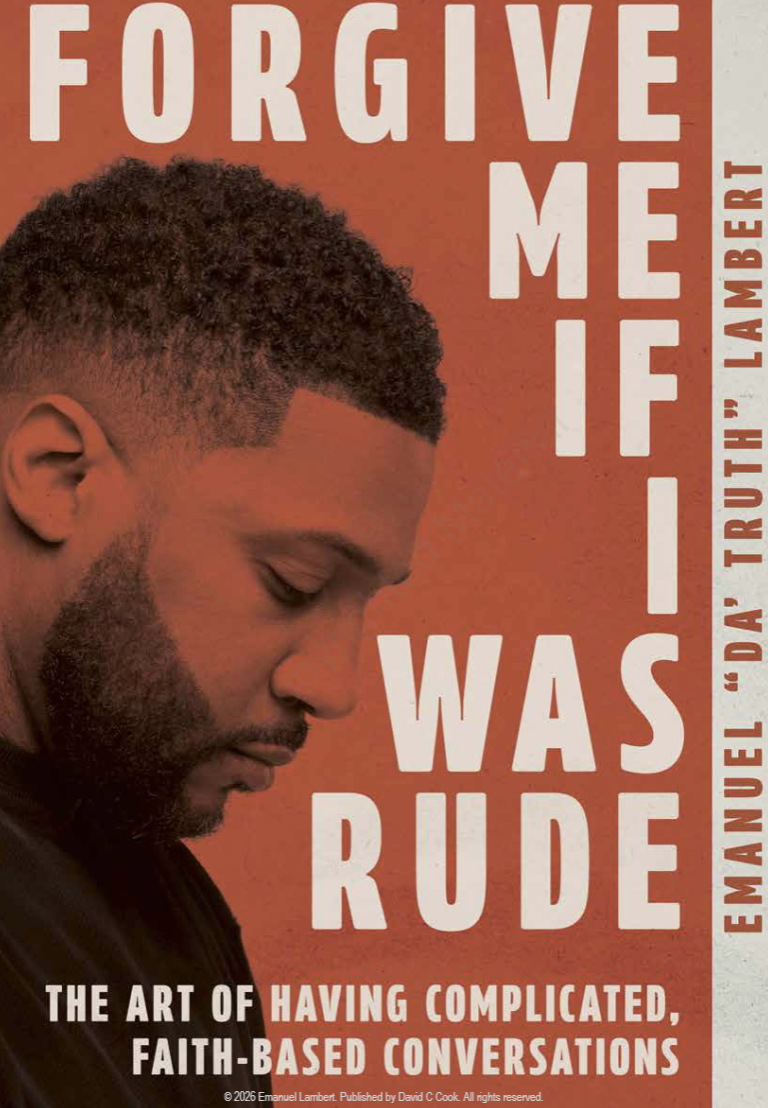
by Emanuel Lambert
A Book Review
#ForgiveMeIfIWasRude #NetGalley
What Is This Book Trying to Do?
There are conversations many of us would rather avoid.
We know the subjects. Faith. Morality. Sexuality. Truth. The things about which people hold deeply rooted convictions and where a badly chosen sentence can turn a conversation into an argument remarkably quickly.
Forgive Me If I Was Rude begins in that uncomfortable space.
Emanuel Lambert sets out to provide Christians with a framework for having difficult conversations without sacrificing either conviction or relationship. The premise is attractive. How do we tell the truth as we understand it while treating the person sitting opposite us with genuine compassion?
This is not simply a book about finding better arguments. It also promises help with remaining physically and emotionally grounded when discussions become tense. Each chapter concludes with a “Curious Conversation”, modelling an exchange between a Christian and a sceptic, including objections, responses and rebuttals.
There is much here that feels timely. But there are also some important questions to ask.
Why Do We Find These Conversations So Difficult?
Perhaps because the stakes are higher than we sometimes acknowledge.
What I regard as an interesting theological question may touch very personally on somebody else’s life, relationships or identity. Something I approach as an idea to be discussed may be something the other person experiences much closer to home.
Then there is the fear of disagreement itself.
We can become frightened of saying the wrong thing, frightened of being misunderstood, or so determined not to offend that meaningful conversation never takes place at all. At the opposite extreme, Christians can confuse boldness with bluntness and congratulate themselves for “speaking truth” without asking whether they have spoken it lovingly.
A book that helps us negotiate that territory could therefore be valuable.
The Framework: Does It Actually Help?
There is much to commend in the concept Lambert offers.
Confidence in difficult conversations does not have to mean becoming more forceful. Learning to remain calm, listening carefully and thinking about how we communicate rather than merely what we communicate are worthwhile disciplines.
I am particularly interested in the book’s modelled “Curious Conversations”. There is considerable value in seeing an approach demonstrated rather than simply being given principles.
But model conversations also present a difficulty.
Real people rarely follow scripts.
They don’t necessarily raise the objection we have prepared for. They bring experiences, hurts, assumptions and histories into conversations with them. A beautifully constructed answer may be logically impeccable and still fail to address what the person is really asking.
So the usefulness of these examples will depend, for me, on whether they teach readers how to listen, rather than simply providing answers to remember.
Truth and Relationship
This is where the book’s central challenge becomes particularly interesting.
Do we really have to choose between truth and relationship?
Christian conversation surely requires more than choosing the right words with which to deliver a predetermined conclusion. It requires humility, including the possibility that while my convictions may be firmly held, my understanding is not exhaustive.
Jesus’ encounters with people repeatedly remind Christians that truth is never merely information. The manner in which we encounter another human being matters.
That does not require pretending disagreement does not exist. Genuine relationships should be capable of carrying disagreement.
But preserving a relationship cannot simply become a communication technique. If kindness is being employed primarily because it increases my chances of persuading somebody, it is no longer quite the same thing as kindness.
The other person must matter irrespective of whether that person ever agrees with me.
Conversation or Conversion?
The publisher describes the goal as not “to win arguments but to win hearts”. I understand what that expression is trying to convey, but it is the phrase that gives me greatest pause. What happens if I enter every conversation believing that my task is ultimately to win something? Am I truly listening to understand the person sitting opposite me, or am I listening for the opening through which I can make my case?
There is an important distinction.
Christian faith is naturally something Christians want to share. There is nothing inherently wrong with persuasion. But conversation becomes something different if one participant unknowingly becomes the object of the other’s strategy. Sometimes a faithful conversation may end without resolution. Two people may understand each other better and still disagree.
Perhaps that is not failure.
Perhaps learning to remain in relationship across genuine difference is itself an important Christian witness.
What Gave Me Pause?
The subjects identified in the description include morality and sexuality, alongside religion and truth. These are areas in which abstract arguments can have deeply personal consequences.
That makes empathy essential rather than decorative.
I would therefore approach the sample dialogues with a particularly critical eye. Are the sceptics allowed to make genuinely difficult arguments? Are questions permitted to remain difficult? Do the conversations resemble encounters between equals, or does one participant largely exist to provide objections that the other can successfully answer?
There is also a bigger question surrounding “biblically-based answers”.
The desire to take Scripture seriously is commendable. But Christians themselves sometimes disagree about how particular passages should be interpreted or applied. Acknowledging that complexity need not weaken conviction. It can demonstrate intellectual and spiritual humility.
Would I Actually Use It?
Potentially, yes.
As a church leader, I find the book’s central concern highly relevant. Difficult conversations are unavoidable. We need to learn how to disagree without dehumanising one another, and how to remain present when a conversation becomes uncomfortable.
I would particularly value anything that helps Christians become calmer, more curious and better listeners.
But I would want to use the framework as a set of tools rather than a script. The measure of success would not be whether I emerged having delivered the perfect Christian response. It would be whether the person with whom I disagreed nevertheless felt heard, respected and safe enough to talk to me again.
The Verdict
Forgive Me If I Was Rude tackles an important problem. Christians need to become better at difficult conversations, particularly in a culture where disagreement can so quickly become hostility.
Its attempt to hold conviction and compassion together is therefore worthwhile. Yet perhaps the greatest challenge lies one step beyond learning how to say difficult things well. It is learning to approach another person without treating them as an argument to be won. Truth matters. Courage matters. The ability to articulate what we believe matters. But so does curiosity. So does humility. So does listening long enough to discover that the person across the table is considerably more complicated than the position they appear to represent.
Perhaps the art of complicated,
faith-based conversation begins there.
Leave a Reply