Introduction: Prolegomena in the Modern Theological Landscape
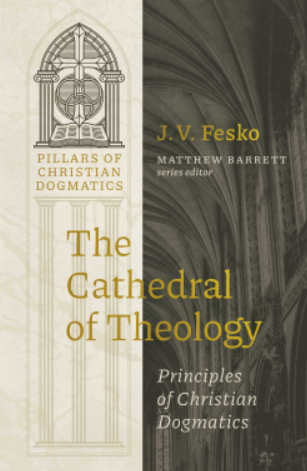
Theological prolegomena has undergone significant transformation in the post‑Enlightenment era. Modern and late‑modern approaches often relocate theology’s foundations from metaphysics and divine revelation to linguistic analysis, phenomenology, political theory, or cultural hermeneutics. In this context, J. V. Fesko’s The Cathedral of Theology represents a deliberate and confident retrieval of classical Christian dogmatics. It is not merely a textbook on theological method; it is a constructive intervention in contemporary theological discourse, arguing that the future of Christian theology depends on recovering the methodological stability of the Great Tradition.
Fesko’s work stands within a growing movement of classical theological retrieval, alongside figures such as Matthew Levering, Michael Allen, Scott Swain, and others. Yet Fesko’s contribution is distinct: he writes from a confessional Reformed perspective while engaging generously across traditions, and he frames his entire project through the architectural metaphor of a cathedral—an image that shapes both the structure and the aesthetic of the book.
The Architectural Metaphor: Theology as a Cathedral
The cathedral metaphor is not merely illustrative; it is methodological. Fesko argues that theological construction requires:
- a foundation (prolegomena),
- pillars (major dogmatic loci),
- walls and windows (doctrinal articulation), and
- ornamentation (theological beauty).
This metaphor allows Fesko to emphasize the interdependence of theological disciplines. Exegesis, metaphysics, doctrinal formulation, and spiritual formation are not isolated tasks but integrated components of a single architectural project. The metaphor also foregrounds the aesthetic dimension of theology—an aspect often neglected in modern dogmatics.
The Nature of Theology: Retrieval Against Reduction
Fesko begins by defining theology as the disciplined, reverent contemplation of the triune God revealed in Scripture and nature. This definition stands against modern reductions of theology to:
- religious experience (Schleiermacher),
- linguistic practice (Lindbeck),
- political praxis (liberation theology), or
- cultural hermeneutics (postmodern theology).
Fesko does not dismiss these approaches outright; rather, he argues that they become distortions when detached from the classical conviction that theology is fundamentally about God and grounded in God’s self‑revelation. His retrieval of classical definitions—Augustine’s fides quaerens intellectum, Aquinas’s sacra doctrina, and Turretin’s theologia—anchors his project in the Great Tradition.
Virtues of the Theologian: Moral Formation as Method
One of the book’s most compelling contributions is its insistence that theological method is not merely intellectual but moral. Fesko argues that theologians must cultivate virtues such as:
- humility,
- patience,
- charity,
- reverence,
- and a love of truth.
This emphasis aligns with patristic and medieval convictions that theology is a habitus, a disposition shaped by grace. It also challenges the modern academic tendency to treat theology as a purely technical discipline. Fesko’s retrieval of virtue ethics within theological method is both timely and necessary.
Revelation, Knowledge, and Metaphysics
Fesko’s treatment of revelation is classical and covenantal. He affirms:
- natural revelation (in creation),
- supernatural revelation (in Scripture),
- and the necessity of the Spirit’s illumination.
His discussion of the relationship between divine and human knowledge is philosophically careful. He avoids both:
- rationalism (which assumes human knowledge can mirror divine knowledge), and
- scepticism (which denies meaningful correspondence between human and divine knowledge).
Instead, he retrieves the classical doctrine of analogy, drawing on Aquinas, Junius, and Bavinck. This section is one of the book’s strongest, offering a clear alternative to modern epistemological instability.
Fesko’s defence of metaphysics is equally significant. He argues that metaphysics is unavoidable and necessary for theology, but must be disciplined by Scripture. This position challenges both anti‑metaphysical biblicism and metaphysical speculation detached from exegesis.
Hermeneutics and the Organization of Theology
Fesko’s hermeneutical principles are grounded in:
- grammatical‑historical exegesis,
- canonical interpretation,
- covenant theology,
- and the regula fidei (rule of faith).
He argues that theology must be organized in a Trinitarian and covenantal structure, reflecting the order of God’s self‑revelation. His discussion of theological architecture—how doctrines relate, how dogmatics should be structured, how theological systems maintain coherence—is both classical and constructive.
Imagination and Beauty: Expanding the Scope of Prolegomena
Two chapters stand out as unusually rich for a work of prolegomena:
Imagination
Fesko argues that imagination is not a threat to theology but a gift. When disciplined by Scripture and tradition, imagination helps theologians:
- contemplate mysteries,
- visualize doctrinal relationships,
- appreciate theological aesthetics,
- and articulate truths that transcend empirical description.
This is a bold and refreshing contribution, expanding the scope of theological method beyond rational analysis.
Beauty
Fesko’s final chapter on beauty is a theological delight. He argues that theology must be:
- true,
- good,
- and beautiful.
Beauty is not ornamental but essential, reflecting the glory of the triune God. This aesthetic dimension aligns with classical Christian thought—from Augustine to Edwards—and challenges modern tendencies to treat theology as merely functional or utilitarian.
Critical Evaluation
Fesko’s work is a monumental achievement, but it is not without limitations.
1. Confessional Particularity
Fesko writes from a Reformed perspective. While he engages broadly, his commitments shape the book’s structure. Readers outside the Reformed tradition will benefit, but may need to translate certain categories.
2. Academic Density
This is not a popular‑level book. It assumes familiarity with classical theological categories, metaphysics, and historical theology. For seminary students and scholars, this is a strength; for general readers, it may be challenging.
3. Breadth Over Depth
As a work of prolegomena, the book covers many topics. Some sections feel introductory, though this is appropriate for the genre.
Conclusion: A Monumental Contribution to Contemporary Dogmatics
The Cathedral of Theology is one of the most substantial contemporary treatments of theological prolegomena. Fesko retrieves the classical Christian tradition with clarity, confidence, and pastoral sensitivity. His integration of exegesis, metaphysics, doctrinal formulation, virtue ethics, imagination, and beauty is rare in modern theological literature.
For seminary students, pastors, and scholars committed to building a durable theological “cathedral,” this book is indispensable. It is a work that will shape theological method for years to come.