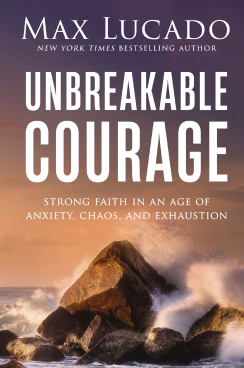
Some voices carry a kind of spiritual steadiness that feels like a hand on the shoulder—gentle, reassuring, and quietly authoritative. Max Lucado has long been one of those voices. For decades, he has offered readers a blend of biblical insight, storytelling warmth, and pastoral compassion that feels like a deep breath in a frantic world. In Unbreakable Courage, he returns with a message that could not be more timely: courage is not the absence of fear, but the presence of God in the midst of it.
The premise of the book is simple but powerful. Lucado takes readers back to the story of Elijah, one of Scripture’s most compelling and complex prophets. Elijah lived in a time of upheaval—spiritual drought, political corruption, cultural confusion, and emotional exhaustion. His world was fractured, contentious, and spiritually dry. In other words, it looked a lot like ours.
Lucado draws this parallel with remarkable clarity. He doesn’t sensationalize the times we live in, nor does he minimize the very real anxiety, division, and fatigue that define modern life. Instead, he gently places Elijah’s story alongside our own and invites readers to see what Elijah saw: a God who remains faithful, present, and powerful even when everything around us feels unstable.
The book opens with a recognition that many readers will resonate with immediately: the constant stream of difficult news, the sense of cultural disorientation, the exhaustion that comes from trying to stay hopeful in a world that feels increasingly chaotic. Lucado names these realities without dramatizing them. His tone is steady, pastoral, and deeply human. He understands the emotional weight people carry, and he writes as someone who has carried it too.
From there, Lucado guides readers through key moments in Elijah’s life—his bold confrontation with Ahab, his prayer for rain, his triumph on Mount Carmel, his collapse under the broom tree, and his encounter with God in the gentle whisper. Each scene becomes a window into the kind of courage God cultivates in His people: courage rooted not in personality or strength, but in trust.
One of the book’s greatest strengths is Lucado’s ability to make ancient Scripture feel immediate. He doesn’t merely retell Elijah’s story; he brings it to life. Readers feel the drought, the tension, the fear, the loneliness. They feel Elijah’s exhaustion and his desperation. And through it all, they see the God who sustains him—sometimes through miracles, sometimes through silence, sometimes through simple provision like rest and food.
Lucado’s writing is characteristically warm and accessible. He speaks to the reader, not at them. His tone is conversational, encouraging, and infused with hope. He has a gift for taking familiar biblical stories and revealing fresh layers of meaning without ever sounding academic or heavy‑handed. His illustrations—drawn from personal experiences, pastoral encounters, and everyday life—give the book a grounded, relatable feel.
Thematically, Unbreakable Courage is a field manual for faith in difficult times. Lucado highlights several practices drawn from Elijah’s life:
- Waiting for God in solitude and silence
- Praying bold, impossible prayers
- Living with expectation that God can disrupt the ordinary
- Turning to God in emotional lows rather than withdrawing
- Recognizing the spiritual battles beneath our struggles
These themes are not presented as formulas but as invitations—gentle reminders that courage grows in the soil of trust, and trust grows when we make space for God.
Lucado also addresses the emotional dimension of faith with unusual tenderness. He acknowledges that even the strongest believers can feel overwhelmed, discouraged, or afraid. Elijah himself reached a breaking point, collapsing under the weight of exhaustion and despair. Lucado handles this moment with pastoral sensitivity, reminding readers that God does not shame Elijah for his weakness. Instead, God meets him with rest, nourishment, and a whisper of reassurance. It is one of the most moving sections of the book, and Lucado’s reflections on it are among his finest.
From a craft perspective, the book is beautifully paced. Lucado alternates between biblical exposition, personal storytelling, cultural reflection, and practical application. The chapters are concise but rich, making the book easy to read yet deeply nourishing. His prose is clear, warm, and unpretentious—qualities that have made him beloved by millions of readers.
The early reviewers’ praise is well‑earned. Many describe the book as “life‑giving truth,” “spiritual ammunition,” and “a refreshing rain on a dry, dusty land.” These are not exaggerations. Lucado’s writing has always had a way of settling the restless heart, and Unbreakable Courage may be one of his most timely offerings. In an age marked by anxiety, division, and exhaustion, his words feel like a steadying hand.
Who is this book for? Anyone who feels overwhelmed by the times we live in. Anyone who longs for hope. Anyone who needs a reminder that God is still present, still powerful, and still working. It is especially meaningful for readers walking through seasons of fear, burnout, or spiritual dryness. Lucado’s voice is gentle enough for the hurting and strong enough for the weary.
In the end, Unbreakable Courage is not just a book about Elijah. It is a book about the God of Elijah—the God who speaks in whispers, who strengthens the fainthearted, who sends rain after drought, and who calls His people to stand firm even when the world feels unsteady. Lucado reminds readers that courage is not something we muster; it is something God cultivates in us as we lean into His presence.
This is a book that will calm fears, steady hearts, and renew hope. It is a timely reminder that while the world may feel chaotic, God remains unchanging—and His courage is available to all who seek Him.