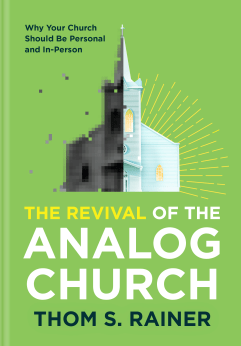
The Revival of the Analog Church: Why Your Church Should Be Personal and In-Person by Thom S. Rainer
a review
Thom S. Rainer’s The Revival of the Analog Church is a timely, countercultural call to rediscover the heart of Christian community in an age dominated by screens, speed, and digital distraction. It is not a rejection of technology but a reordering of priorities: a reminder that the church’s power has always been found in presence, embodied relationships, and shared life.
The Core Vision of the Book
Rainer argues that the church’s greatest gift to a weary, anxious world is not better production quality or more online content, but intentional, in-person presence. He frames the analog church as:
- a place where the pace slows
- a community where people are truly seen
- a countercultural refuge from digital noise
- a space where discipleship is lived, not streamed
The book’s central conviction is simple and compelling: people need people, and the church is at its best when it leans into that truth.
Key Themes
Sacred Slowness
Rainer highlights the biblical rhythm of slowness—meals, journeys, conversations on the road. Scripture unfolds at a human pace, and Jesus models ministry that is unhurried, relational, and deeply attentive. The analog church mirrors this pace, offering a sanctuary from the relentless speed of digital life.
Embodied Presence
The book insists that presence is not optional for Christian community. Jesus taught face to face, comforted with touch, and discipled through shared life. Rainer challenges churches to reclaim this incarnational model, especially in a culture increasingly mediated by screens.
Discipleship in Community
Rainer argues that discipleship cannot be reduced to content consumption. It requires accountability, shared rhythms, and the messy, beautiful work of walking with others. The analog church becomes the place where faith is formed through relationships, not broadcasts.
Resisting Digital Allure
Without demonizing technology, Rainer warns against allowing smartphones, social media, and livestream culture to reshape the church’s identity. The danger is subtle: churches can become content producers rather than communities of transformation. The book calls leaders to resist this drift.
Strengths of the Book
- Clear, pastoral writing that speaks directly to the realities of modern ministry
- A hopeful tone—not nostalgic, but forward-looking and grounded in Scripture
- Practical guidance for churches wanting to re-center presence and community
- A prophetic edge that challenges leaders to examine their assumptions about success, growth, and relevance
Rainer’s examples are relatable, and his theological grounding gives the book a weight that resonates across traditions.
Why This Book Matters Now
Many churches emerged from the pandemic with hybrid models, livestream habits, and a subtle anxiety about attendance. Rainer’s book offers a gentle but firm recalibration: technology can support ministry, but it cannot replace the embodied life of the church.
In a world marked by loneliness, fragmentation, and digital fatigue, the analog church becomes a place of healing—where people encounter God not through pixels but through presence.
Who Will Benefit Most
- Pastors discerning the future shape of their congregations
- Leadership teams evaluating digital strategies
- Churches longing to rebuild community after seasons of disconnection
- Readers who sense that something essential is lost when faith becomes disembodied
A Pastoral Reflection
Rainer’s vision resonates deeply with the biblical story: God with us, God among us, God in the flesh. The analog church is not a retreat into the past but a return to the heart of Christian identity. It invites us to slow down, to look one another in the eye, and to rediscover the sacredness of gathering.
 I write about Stuff
Leave a comment