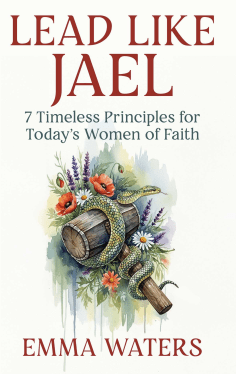
Lead Like Jael: 7 Timeless Principles for Today’s Women of Faith by Emma Waters
There is something visceral about Jael. Her story in Judges 4 is brief, fierce, and unforgettable. She is courageous, decisive, and unafraid to act when the moment demands it. Many women of faith read her story and wonder, Could I ever be that brave? Could I ever lead with that kind of clarity and courage? That longing — that pull toward a deeper, steadier strength — is what makes Emma Waters’ Lead Like Jael such a compelling and timely book.
Waters writes into a cultural moment where visions of womanhood are often polarised: the “girl‑boss” ideal on one side, the “tradwife” movement on the other. Both, she argues, offer partial and ultimately insufficient pictures of what it means to be a woman of strength, wisdom, and purpose. Instead of these cultural extremes, Waters turns to Scripture — to Lady Wisdom in Proverbs and to the women of the Old and New Testaments — to recover a fuller, richer, more grounded vision of female leadership.
A biblical alternative to cultural extremes
Waters’ central argument is that Christian women do not need to choose between ambition and domesticity, between leadership and nurture, between courage and gentleness. The biblical narrative offers a more integrated vision. Women like Deborah, Ruth, Abigail, Priscilla, and yes, Jael, demonstrate that strength and femininity are not opposites but partners. They lead, influence, negotiate, protect, nurture, and act decisively — all without abandoning the unique gifts of womanhood.
For ministry leaders, this is a refreshing and necessary reframing. Many women in the church feel caught between cultural expectations and spiritual calling. Waters’ work provides language that honours both the complexity and the dignity of women’s leadership in God’s story.
Seven strands of wisdom for today’s women
The book is structured around seven principles drawn from Lady Wisdom and embodied by biblical women:
- Discernment — the ability to read a moment, a person, or a situation with spiritual clarity.
- Shrewdness — not manipulation, but wise strategy rooted in righteousness.
- Resourcefulness — the creative, practical intelligence that women have always brought to households, communities, and crises.
- Life‑giving hospitality — not merely entertaining, but creating spaces where others flourish.
- Marriage on mission — seeing partnership as a shared calling rather than a hierarchy.
- Motherhood as warfare — recognising the spiritual weight of forming the next generation.
- Wise counsel and negotiation — the quiet but powerful influence women often wield in shaping decisions.
These strands are not presented as rigid roles but as invitations — ways of being that help women lead with courage, integrity, and faithfulness.
Jael as a model of decisive, grounded leadership
Waters’ use of Jael is particularly striking. Jael is not a warrior in the traditional sense. She does not pick up a sword. She uses what is in her hands — a tent peg, a tool of domestic life — to secure victory for Israel. Waters draws out the theological significance of this: God honours the courage of women who act faithfully with what they have, where they are, in the roles they inhabit.
The book’s most memorable line captures this beautifully: “Like Jael directing the tent peg that secured victory for Israel, wise women today fasten their homes and their hearts to Christ, the true Wisdom. Rooted in Him, they plant each stake deeply, building families, communities, and legacies that can endure the fiercest storm.”
For pastors and ministry leaders, this is a powerful image to bring into sermons, women’s ministry, leadership training, and pastoral conversations. It reframes leadership not as platform but as faithfulness.
Strengths and pastoral value
Waters writes with clarity, conviction, and deep respect for Scripture. Her critique of cultural narratives is thoughtful rather than reactionary, and her vision of biblical womanhood is both challenging and freeing. The book is especially valuable for:
- women discerning their calling
- leaders shaping women’s ministry
- pastors preaching on biblical women
- communities seeking a healthier theology of gender and leadership
Some readers may wish for more engagement with women who lead in explicitly public or vocational ministry roles, but the book’s focus on wisdom, character, and influence makes it widely applicable.
A closing reflection
Lead Like Jael is a bold, thoughtful, and empowering call for women to lead with courage, wisdom, and faithfulness. It honours the strength of biblical women and invites today’s women to step into their God‑given influence — not by imitating cultural models, but by rooting themselves in Christ, the true Wisdom.
 I write about Stuff
Leave a comment