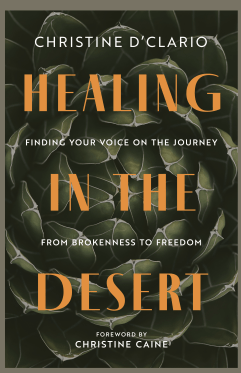
Healing in the Desert: Finding Your Voice on the Journey from Brokenness to Freedom by Christine D’Clario – Book Review
Christine D’Clario’s Healing in the Desert is a deeply personal and pastorally significant book, written from the intersection of worship, trauma, mental health, and spiritual formation. Known internationally as a worship leader, D’Clario steps away from the stage lights to tell the truth about her own breakdown, her battle with depression, and the long, ongoing journey toward healing. What emerges is not a celebrity testimony but a compassionate, grounded invitation for Christians to care for the whole person—body, mind, and soul—without guilt, fear, or shame.
A story that gives permission
D’Clario’s vulnerability is the book’s greatest strength. She writes openly about suicidal thoughts, childhood trauma, and the crushing pressure of ministry expectations. For pastors and worship leaders, her honesty offers something rare: permission. Permission to admit exhaustion. Permission to name anxiety. Permission to acknowledge that spiritual maturity does not cancel emotional pain. In a church culture that often prizes strength, certainty, and constant availability, D’Clario’s story gently dismantles the myth that faith and fragility cannot coexist.
Her narrative also exposes the ways churches sometimes unintentionally deepen wounds—offering spiritual clichés instead of holistic care, or treating mental health struggles as failures of faith. By naming these patterns, she opens space for healthier, more compassionate ministry.
Holistic care rooted in Scripture
One of the book’s central contributions is its insistence that emotional and mental health are not separate from spiritual life but woven into it. D’Clario draws on Scripture, research, and her own therapeutic journey to show that God’s healing work touches every part of who we are. She challenges the false divide between “spiritual issues” and “emotional issues,” arguing instead for a whole‑person approach that honours the way God created us.
For ministry leaders, this is a crucial corrective. It encourages pastors to normalise therapy, to speak openly about mental health, and to create church cultures where vulnerability is welcomed rather than hidden. Her reflections on burnout, boundaries, and the pressure to perform are particularly relevant for those in public ministry roles.
A resource for worshipping communities
Because D’Clario writes as a worship leader, the book has a unique resonance for those who shape the worship life of the church. She explores how unhealed wounds can distort our sense of calling, how trauma can silence our voice, and how worship can become either a mask or a means of healing. Her language of “finding your voice” is both metaphorical and practical—an invitation to reclaim identity, agency, and authenticity before God.
For congregations, the book offers a compassionate lens through which to understand the struggles many people carry quietly into church. It encourages communities to move beyond quick fixes and toward patient, relational care. It also provides pastors with language to speak about suffering without minimising it and hope without oversimplifying it.
Strengths and limitations
The book’s strengths lie in its honesty, accessibility, and pastoral warmth. D’Clario writes with the tone of someone who has lived what she describes, and her integration of Scripture feels organic rather than forced. Her emphasis on holistic care is timely and necessary.
Some readers may wish for more theological depth or a more structured exploration of trauma and healing. The book leans heavily on personal narrative, which is powerful but may leave academically minded readers wanting more. However, for ministry practitioners, the balance of story, Scripture, and practical wisdom is likely to be exactly what is needed.
A closing reflection
Healing in the Desert is a gift to the church—a reminder that God meets us not in our perfection but in our need. It offers a path toward healing that honours every part of how God made us and invites us to pursue wholeness with courage and grace. For pastors, worship leaders, and anyone walking alongside those who suffer, this book provides both companionship and practical guidance. It is a tender call to create communities where brokenness is not hidden, and healing is not rushed, but where every voice—especially the wounded one—is welcomed and heard.
 I write about Stuff