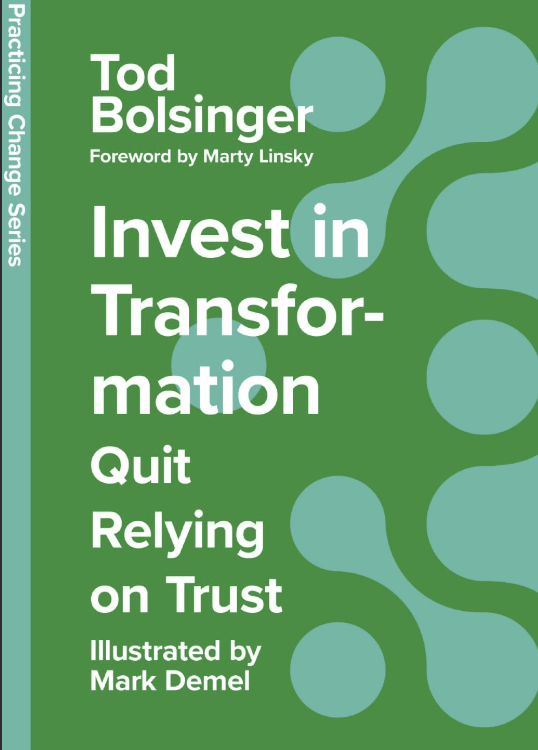
Book Report: Invest in Transformation: A New Path by Tod Bolsinger
Introduction
Tod Bolsinger’s Invest in Transformation: A New Path Forward arrives at a moment when many communities—churches, organisations, and civic groups alike—are wrestling with distrust, fatigue, and uncertainty about the future. Bolsinger, known for his influential work on adaptive leadership, argues that genuine transformation is impossible without a deliberate, sustained investment in trust. In a world where skepticism often clouds judgment and institutions struggle to maintain credibility, he offers a compelling roadmap for leaders who long to cultivate unity, resilience, and meaningful change. Trust, he insists, is not a sentimental ideal but a strategic, relational resource that must be stewarded with wisdom and courage.
Summary of Key Themes
1. Trust as the Foundation of Transformation
Bolsinger’s central claim is both simple and profound: there is no transformation without trust. While leaders often focus on vision, strategy, or innovation, he reminds us that none of these can take root in a community where trust has eroded. Trust is the soil in which transformation grows. It is fragile, easily damaged, and slow to rebuild, yet it is the only environment where people feel safe enough to risk change. Bolsinger emphasises that trust is not transformation itself—leaders must still do the hard work of guiding adaptive change—but trust is the essential precondition that makes transformation possible.
2. Wisdom for Growth and Renewal
Drawing on years of leadership coaching and pastoral experience, Bolsinger offers practical wisdom for leaders seeking to revive trust in communities that have experienced disappointment, conflict, or stagnation. He highlights the importance of consistency, humility, and relational presence. Leaders must be willing to listen deeply, acknowledge past failures, and demonstrate a commitment to shared values. This wisdom is not abstract; it is grounded in the lived realities of congregations and organisations navigating cultural shifts, declining engagement, and internal tensions. Bolsinger’s insights help leaders recognise the emotional and relational dynamics that shape a community’s capacity for growth.
3. Practical Leadership Tools for Real-World Change
One of the strengths of the book is its blend of theory and practice. Bolsinger provides concrete tools that leaders can immediately apply: frameworks for diagnosing resistance, exercises for team reflection, and strategies for cultivating resilience during seasons of uncertainty. These tools are designed not only for individual leaders but for teams who must learn to navigate change together. Bolsinger’s approach is deeply pastoral yet organisationally savvy, making the book valuable across sectors—from ministry to education to non-profit leadership.
4. Engaging, Accessible, and Visually Rich Content
The book’s structure reflects Bolsinger’s commitment to accessibility. Each chapter is brief, engaging, and filled with colourful illustrations that translate complex leadership concepts into memorable images. These visual elements help readers grasp the dynamics of trust-building, adaptive leadership, and communal transformation. The writing style is warm and conversational, inviting leaders to reflect on their own habits, assumptions, and blind spots. This makes the book particularly suitable for group study, leadership retreats, or ongoing professional development.
5. Real-Life Scenarios and Case Studies
Bolsinger grounds his insights in real-life examples drawn from churches, non-profits, and institutions undergoing significant change. These case studies illustrate how trust is built, broken, and restored in practice. They also reveal the emotional complexity of transformation—the fear, resistance, hope, and courage that accompany any meaningful shift. The exercises that accompany these scenarios encourage teams to process insights together, making the book a practical tool for collaborative learning. Leaders are invited not only to understand transformation intellectually but to experience it relationally.
Critical Evaluation
Invest in Transformation is a timely and necessary contribution to contemporary leadership literature. Bolsinger’s emphasis on trust resonates deeply in contexts where leaders face declining participation, cultural suspicion, or internal division. His writing is clear, compassionate, and grounded in real-world experience. Some readers may desire deeper theological engagement or more extensive analysis of systemic challenges, but the book’s strength lies in its clarity and practicality. It serves as an accessible entry point for leaders who need both encouragement and concrete guidance. Bolsinger’s ability to blend academic insight with pastoral sensitivity makes the book especially valuable for ministry settings.
Implications for Leadership and Ministry
For leaders in faith communities, the implications of Bolsinger’s work are significant. The book encourages leaders to:
- Prioritise relationships over rapid results
- Create environments where vulnerability, honesty, and curiosity are welcomed
- Equip teams to engage in adaptive work rather than relying on technical fixes
- Recognise that trust-building is slow, deliberate, and essential
- Embrace transformation as a communal journey rather than a top‑down initiative
These insights align closely with the needs of contemporary ministry, where collaboration, shared discernment, and emotional intelligence are increasingly vital. Bolsinger’s emphasis on team-based processing makes the book particularly useful for vestries, staff teams, and leadership cohorts seeking to navigate change with integrity.
Conclusion
Invest in Transformation: A New Path Forward offers a hopeful and practical guide for leaders committed to meaningful change. Bolsinger reminds us that transformation is not achieved through charisma, clever strategy, or institutional pressure but through the steady, faithful investment of trust. In a world hungry for authenticity and stability, his invitation to cultivate trust as the foundation for transformation is both challenging and deeply encouraging. Leaders who embrace this path will find themselves better equipped to guide their communities toward resilience, renewal, and shared purpose.
 I write about Stuff
You must be logged in to post a comment.