“Then Jesus took the loaves, gave thanks to God, and distributed them to the people. Afterward he did the same with the fish. And they all ate as much as they wanted.” —John 6:11
John 6:1–21 — When Not Enough Becomes More Than Enough
Wherever Jesus went, crowds followed. They weren’t simply curious; they were captivated. His healing power, His compassion, His authority—people sensed something in Him that they had never encountered before. So when Jesus crossed the Sea of Galilee, hoping for a quiet moment on a remote hillside, the crowds followed Him there too. Five thousand men, plus women and children—an enormous gathering, especially in such an isolated place.
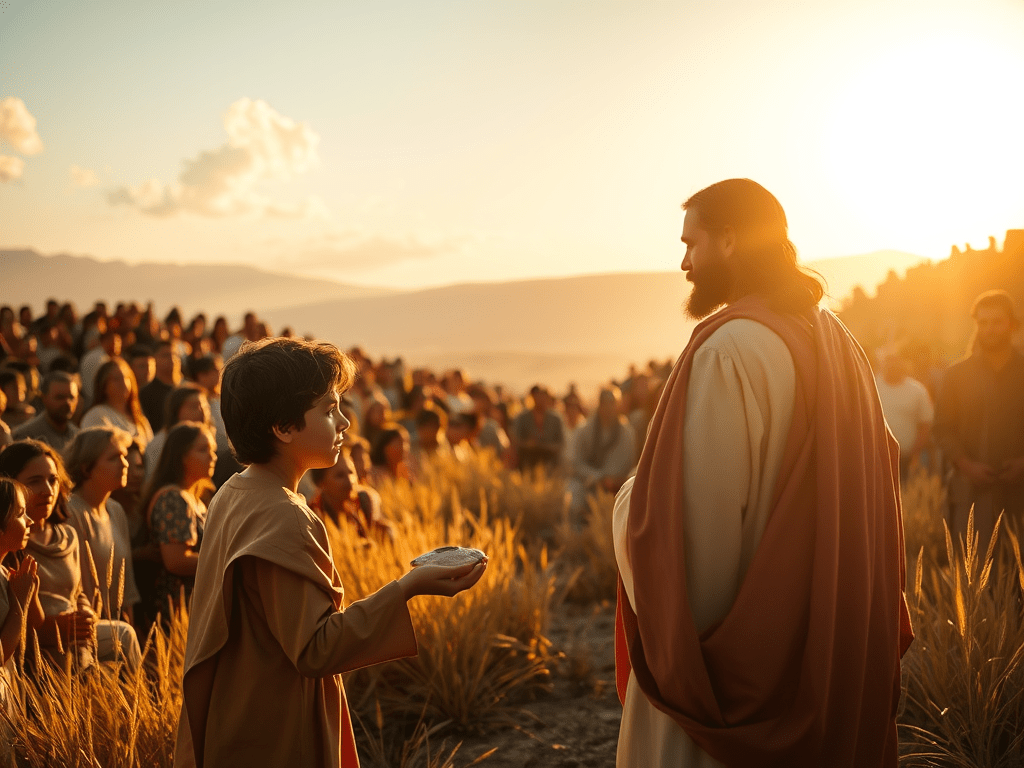
And among all those people, only one person had thought to bring food. A young boy with five barley loaves and two small fish—simple, humble food, the kind a poor family might pack for a child. Nothing impressive. Nothing strategic. Just enough for one.
The disciples immediately felt the impossibility of the situation. They were miles from anywhere that sold food, and even if they could find a place, they couldn’t possibly afford to feed a crowd this size. But Andrew, perhaps feeling slightly foolish, brought the boy to Jesus anyway. It was all he could think to do.
And Jesus received the offering.
Before He multiplied it, before He broke it, before He fed a single person, Jesus paused and gave thanks. He treated the boy’s small lunch as a gift—because that’s exactly what it was. Jesus never despises smallness. He never mocks what looks inadequate. He honours it, blesses it, and transforms it.
Then He began to break the bread. Piece after piece after piece. The disciples must have watched in awe as the loaves and fish didn’t diminish but somehow expanded in His hands. Jesus kept giving, and the disciples kept distributing, until thousands upon thousands had eaten—and not just a polite nibble. They ate until they were satisfied. Until they were full.
The boy’s small offering became a feast for a multitude.
This is one of the great truths of the kingdom: It’s not the size of the gift that matters—it’s the hands it’s placed in. What feels tiny to us can become abundant in the hands of Jesus. What feels insignificant can become the very thing God uses to bless others. The boy didn’t have much, but he had enough. And Jesus made it more than enough.
But the crowd misunderstood the miracle. They were so impressed that they tried to make Jesus their king—imagining a Messiah who would overthrow Rome and meet their political expectations. Jesus refused to be shaped by their agenda. He slipped away into the hills, choosing solitude over applause. He had come to meet their deepest needs, not their loudest demands.
Later that night, the disciples set out across the Sea of Galilee without Him. The lake was notorious for sudden storms, and this night was no exception. As the sun set and the air cooled, fierce winds swept down from the surrounding hills, churning the water into chaos. The disciples rowed for hours, fighting the storm, making almost no progress. Exhaustion, fear, and frustration must have weighed heavily on them.
But the storm that overwhelmed them posed no obstacle to Jesus. He walked across the water—across the very thing that threatened them—and came toward them. In the darkness, they couldn’t recognise Him. They assumed the figure on the waves was a ghost. Fear layered upon fear.
Then came His voice: “Don’t be afraid. I am here.”
Those words changed everything. The disciples welcomed Him into their boat—into their fear, their exhaustion, their struggle. And immediately, they reached the shore. The storm didn’t disappear before Jesus arrived; the miracle happened when they let Him in.
This story reminds us that Jesus meets us in two places: • in our scarcity, where He multiplies what we offer • in our storms, where He brings us safely to shore
His way may feel frightening or unfamiliar at times, but He never abandons us. When we invite Him into our struggles, He ensures we arrive where we need to be.
 I write about Stuff