“But I have a greater witness than John—my teachings and my miracles. The Father gave me these works to accomplish, and they prove that he sent me.” —John 5:36
John 5 — When Jesus Steps Into Human Hopelessness and Reveals Who He Truly Is
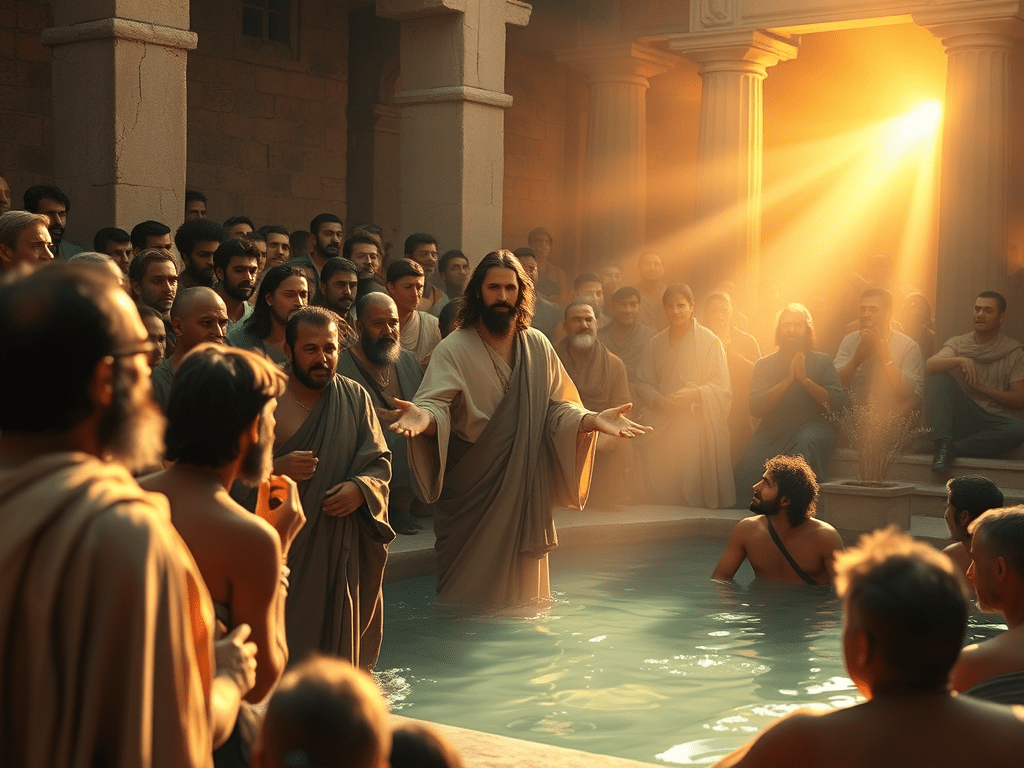
When Jesus returned to Jerusalem for the holy days, He walked straight into one of the most heartbreaking places in the city—the pool of Bethesda. It was a place where hope and despair lived side by side. The pool was surrounded by five covered porches, each crowded with people who were sick, blind, disabled, or paralysed. They gathered there because of a long‑held belief: that from time to time an angel stirred the waters, and the first person to enter the pool afterward would be healed.
Imagine the atmosphere. The longing. The desperation. The quiet competition. People waiting for a miracle they could never quite reach. For some, the pool represented their last fragile thread of hope.
Among them was a man who had been disabled for thirty‑eight years—longer than Jesus had been alive. He had no one to help him into the water. No strength to get there first. No realistic chance of healing. His life had become a cycle of waiting and disappointment.
And then Jesus approached him.
Jesus didn’t wait for the man to prove his faith or articulate perfect theology. He didn’t ask him to crawl closer to the water. He simply spoke a sentence that carried the full authority of heaven: “Stand up, pick up your mat, and walk.”
In an instant, strength surged into legs that had not held him for decades. Muscles responded. Bones aligned. The man stood, picked up his mat, and walked. A miracle—quiet, personal, and utterly transformative.
But instead of celebration, he was met with criticism.
The religious leaders saw him carrying his mat and immediately confronted him—not because they were amazed at his healing, but because he was breaking one of their Sabbath rules. They were so fixated on their regulations that they missed the miracle unfolding right in front of them. They cared more about the mat than the man.
When they discovered that Jesus was responsible, their hostility intensified. They weren’t moved by compassion. They weren’t stirred by wonder. They were threatened. Jesus’ influence was growing, and His actions challenged their tightly controlled system.
Jesus didn’t back down. He made claims that left no room for ambiguity: • He called God His Father—making Himself equal with God. • He declared that His words and actions carried God’s authority. • He claimed the right to judge all humanity. • He insisted that honouring Him was inseparable from honouring God. • He stated that eternal life was found in Him alone.
These were not small statements. They were declarations of divinity.
And then Jesus did something brilliant—He pointed to the witnesses the religious leaders already trusted.
John the Baptist They had respected John, and John’s entire ministry had been built on pointing to Jesus as the Lamb of God.
Jesus’ own works His miracles weren’t random acts of kindness; they were signs given by the Father to reveal who He was.
The Scriptures The very writings the religious leaders studied so diligently—especially the writings of Moses—had been pointing to Jesus all along.
Everything they claimed to honour—John, the Scriptures, Moses—testified to Jesus. Everything pointed to Him. But they refused to see it.
And that’s the tragedy of this passage. The people who knew the Scriptures best missed the One the Scriptures were written about. Their hearts were so hardened by pride, fear, and control that they couldn’t recognise the Messiah standing right in front of them.
Yet for us, this story is a source of deep assurance. Every trustworthy witness—John, Scripture, miracles, the Father Himself—confirms that Jesus is the Son of God, the Messiah, the Saviour. Our faith isn’t built on wishful thinking. It rests on a foundation God Himself has established.
Jesus still steps into places of hopelessness. He still speaks life into situations that feel impossible. He still reveals Himself to those willing to see.
 I write about Stuff