“For this is how God loved the world: He gave his one and only Son, so that everyone who believes in him will not perish but have eternal life.” —John 3:16
John 3 — A Conversation in the Dark That Still Changes Lives
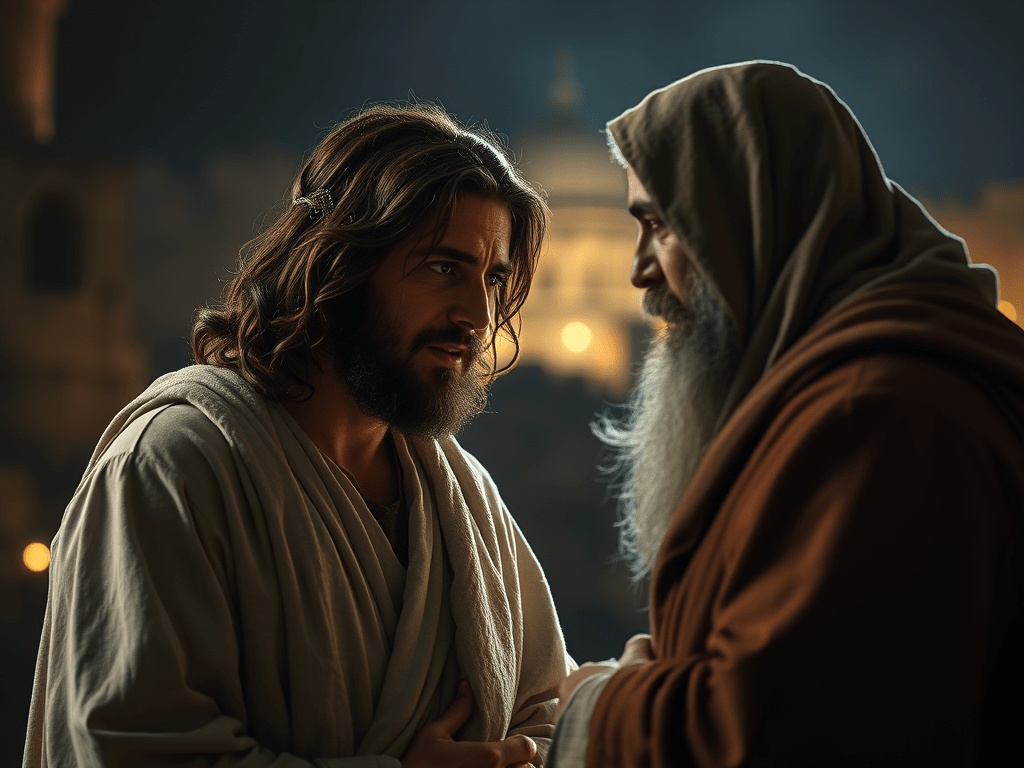
Not every religious leader in Jesus’ day dismissed Him or plotted against Him. Some were genuinely curious—drawn in by His authority, His compassion, and the unmistakable presence of God in His words and actions. Nicodemus was one of those rare souls. A Pharisee, a respected teacher, and a member of the Sanhedrin, he carried influence, education, and status. Yet beneath all of that, something in him stirred when he heard Jesus speak. Something awakened. Something longed for more.
So Nicodemus sought Jesus out—but he came at night. Perhaps he wanted uninterrupted conversation, a chance to ask honest questions without the pressure of the crowds. Or perhaps he was afraid of being seen. After all, curiosity about Jesus was one thing; being associated with Him was another. Whatever his reasons, Nicodemus arrived under the cover of darkness, carrying both his questions and his dignity.
He began respectfully, acknowledging that Jesus must have come from God. “No one could do these signs unless God were with him,” he said. But Nicodemus still placed Jesus in the category of “teacher”—a remarkable one, yes, but still just one among many. Jesus gently but firmly dismantled that assumption. He hadn’t come to offer new ideas or refine old teachings. He had come to offer new life.
This would have been deeply unsettling for Nicodemus. Jewish people believed that their place in God’s kingdom was secured by birth. They were children of Abraham, God’s chosen people. Some rabbis even taught that Abraham himself stood guard at the gates of Hell to ensure none of his descendants slipped in by mistake. Nicodemus had spent his entire life building a spiritual résumé—obedience, discipline, moral excellence. If anyone was “in,” surely he was.
But Jesus told him something radically different: Entrance into God’s kingdom doesn’t come from the first birth—it comes from the second. “You must be born again.”
Nicodemus, understandably, was baffled. He assumed Jesus was speaking about moral renewal or spiritual improvement—something the Pharisees prided themselves on. But Jesus wasn’t talking about self-improvement. He was talking about transformation. A new beginning. A new heart. A new Spirit. Something only God could do.
Then Jesus pointed Nicodemus toward the heart of the gospel: this new birth would only be possible because the Son of Man would be “lifted up.” Lifted up on the cross—bearing the weight of humanity’s sin. Lifted up from the grave—breaking the power of death. Lifted up to Heaven—opening the way for eternal life.
And then comes the verse that has echoed across centuries, whispered in hospital rooms, preached in stadiums, memorized by children, and clung to by the brokenhearted: John 3:16. The entire story of salvation in one breath.
It begins not with human effort, but with divine love. A love we cannot earn. A love we cannot lose. A love that gives—lavishly, sacrificially, completely.
God gave His Son. Not reluctantly. Not cautiously. But freely, knowing the cost.
Jesus came to suffer and die in our place so that everyone—absolutely everyone—who believes in Him will not perish. Belief here is not mere agreement with facts. It is trust. Surrender. Dependence. It is staking your life on the truth that Jesus alone can save.
And the promise? Eternal life. Not just endless existence, but fullness of life—life as God intended it. A life without sickness, sorrow, or decay. A life where joy is unbroken and love is untainted. A life where we are finally, completely whole.
Nicodemus came to Jesus in the dark, but Jesus invited him into the light. And that invitation still stands for every one of us.
 I write about Stuff